Telescope: 130mm Newtonian Reflector.
Eyepiece: Svbony 7–21mm Zoom Eyepiece.
Type: Visual Neptune Observation from Bortle 9 Sky ( New Delhi ).
Rarity: Single Night, Single Attempt Capture.
Observation Summary
Hello everyone,
My name is Rishabh Sagar, and I would like to share a verified planetary observation achieved under challenging urban sky conditions from New Delhi, India.
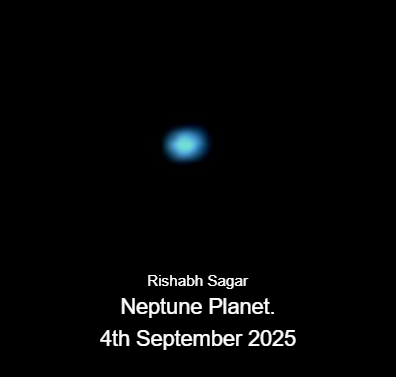
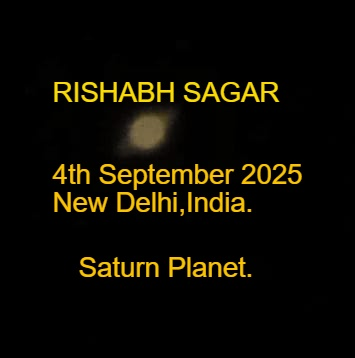
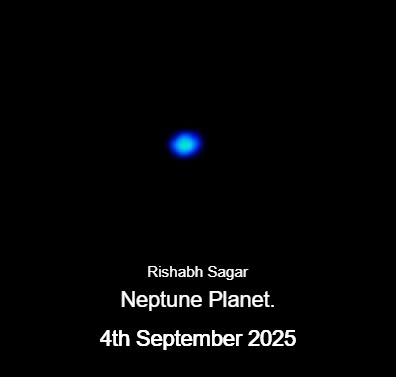
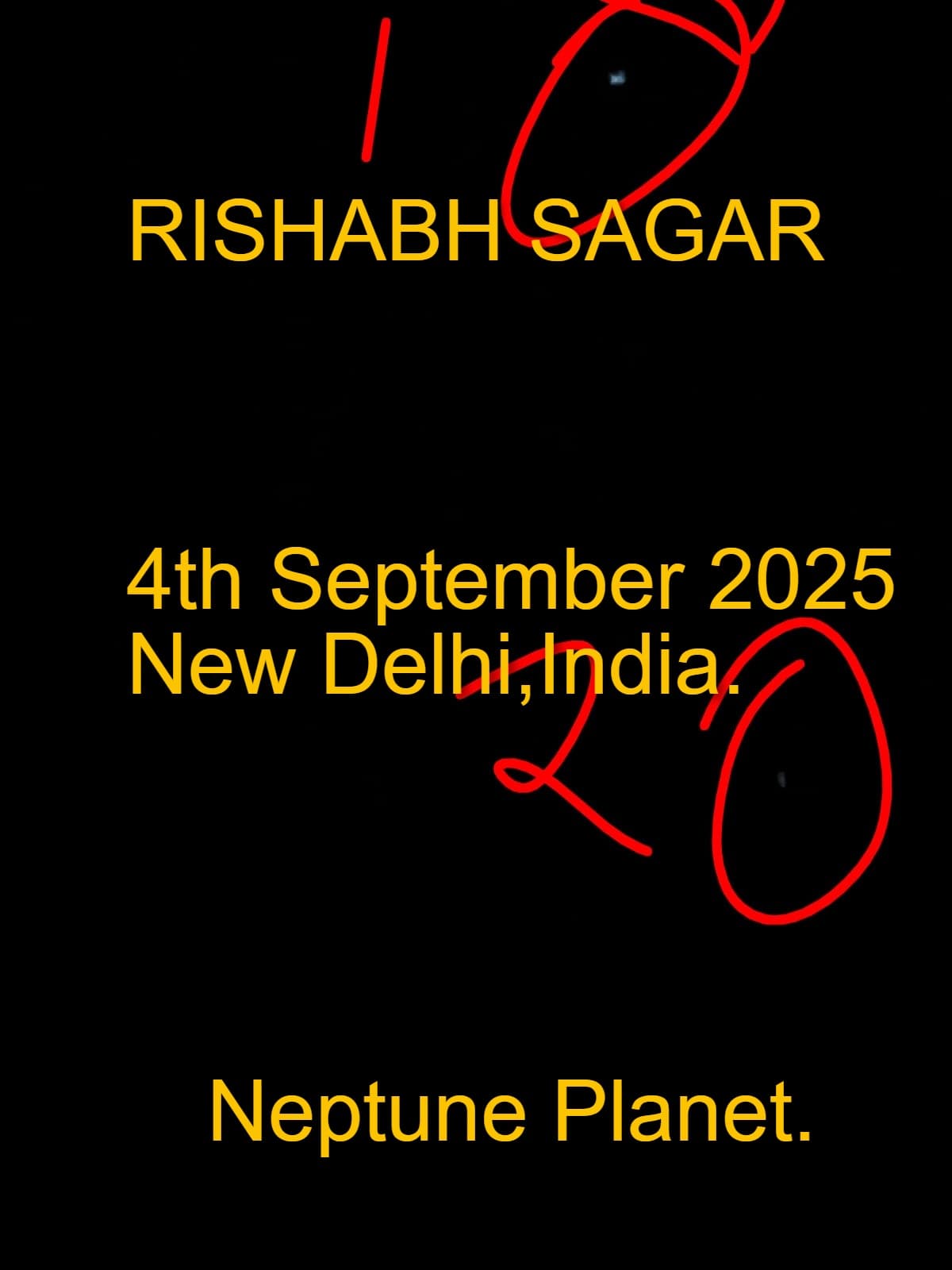
On the night of 4 September 2025, I successfully observed and captured Neptune, along with the nearby reference star TYC 4663-378 (magnitude ~10.8), and Saturn, all within the same session. Despite severe light pollution (Bortle 9), the distinct pale-blue disk of Neptune was visible at high magnification, positioned close to the 10.8-magnitude star, confirming the identification.
This observation has been reviewed and verified by Roger Venable (ALPO Research Team, USA) and has been officially archived in the ALPO Remote Planets Report 2025–2026 as a confirmed planetary visual capture.
Captured & Verified Objects
 Neptune — Magnitude ~7.8
• Pale-blue disk visible; distant ice giant ~4.3 billion km away
 TYC 4663-378 — Magnitude ~10.8
• Field reference star supporting positional verification
 Saturn — Bright yellowish planet, same session capture
Observation Details
 Location: New Delhi, India
 Date: 4 September 2025
 Verification: Roger Venable — ALPO Remote Planets Section
 Archival: ALPO 2025–2026 Remote Planets Report
 Capture Type: Single Night, Single Attempt
Rarity & Technical Significance
Observing Neptune through a 130mm telescope in Bortle 9 urban conditions is an uncommon and technically demanding achievement. Typically, such observations are performed under dark rural skies using larger apertures. Identifying Neptune near a 10.8-magnitude star demonstrates precise star-field matching, careful chart comparison, stable atmospheric timing, and controlled magnification.
This accomplishment highlights the meaningful scientific value that dedicated amateur astronomers can contribute, even with modest equipment, when paired with accurate reporting and independent verification.
Quick Facts about Neptune
- Average Distance from Earth: ~4.3 billion km
- Apparent Magnitude: ~7.8
- Angular Diameter: ~2.3 arcseconds
- Color: Pale-blue (methane absorption)
- Discovery: Johann Galle, 1846 (guided by Le Verrier’s calculations)
Acknowledgments
 Verified & archived by ALPO Remote Planets Section (2025–2026).
 Special thanks to Roger Venable for guidance and confirmation support.
Clear skies & best regards,
Rishabh Sagar
Citizen Scientist || Amateur Astronomer
New Delhi, India