Hi to all.
When iron has been produced in the core of a stflar, what elements will iron be synthesized into?
Thanks
Hi to all.
When iron has been produced in the core of a stflar, what elements will iron be synthesized into?
Thanks
Its seems i read somewhere that iron will be the very last thing a star will make. Once it makes iron it goes boom.
Hi:
Iron is the last element produced by fusion in the core, releasing energy. Once iron formed, the core collapses into a neutron star or black hole.
From cobalt, the process of fusion of new elements absorbs energy. So, elements heavier than iron are synthesized in others process such supernova explosion or merging of neutron stars.
Regards
Hi Angel_Manuel_Lopez,
How do you determine:
Iron is the last element produced by fusion in the core
as a scientific fact for stars?
Thanks,
Kermos
Thanks for the reply.
But the iron in the nucleus fuses with other elements, which remove energy from the nucleus ?
Hi:
Once iron is formed in the core, fusion is stopped. Iron dosen’t fuse, releasing energy. iron is the most stable element.
(The process of fusion to produce iron from silicon needs a temperatura of 3 billion °K).
Fusing iron to yield heavier elements requieres a process that absorbs energy and a star needs to release energy to fight Gravity.
Regards
Once iron is formed in the core, fusion is stopped. Iron dosen’t fuse, releasing energy
If iron doesn’t melt, how does it release energy?
Hi again Angel_Manuel_Lopez,
You write as if scientific fact about the core of stars, yet you neglected Higgs field influence.
Thanks,
Kermos
Hi, it’s the end of the star.No more energy is generated to equal gravity.
Then gravity wins and the core collapses
Regards
Hi, I don’t know Higgs field
Regards
Hola Angel_Manuel_Lopez,
Since you wrote “I don’t know Higgs field”, then you have insufficient science to write as a matter of scientific fact:
it’s the end of the star.No more energy is generated to equal gravity.
Then gravity wins and the core collapses
Thanks,
Kermos
Hey,
It is a widely taught fact that iron is the most stable element and the reasoning is as follows-
Every nucleus contains some amount of energy due to the number of protons and neutrons it contains and the ratio in which these exist.
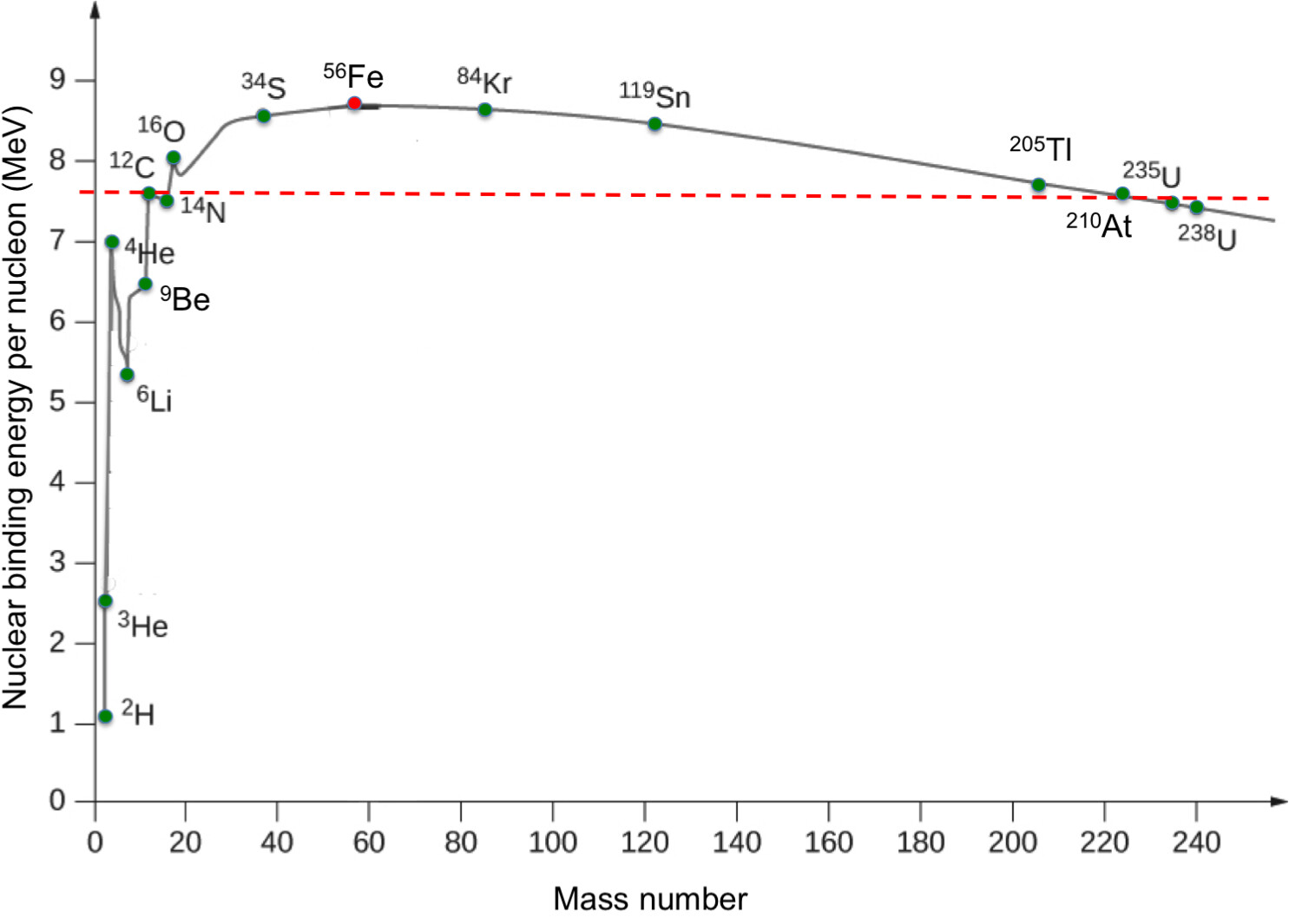
the common way to measure this is the Binding Energy per Nucleon.
when protons and neutrons combine to form a nucleus the total mass of the nucleus is less than the sum of masses of the nucleons. this change in mass is mass defect and using E=mc^2, the total energy in the nucleon is calculated from the amount of mass it apparently loses and this value is then divided by the total number of nucleons to find the binding energy per nucleon.
now, when 2 lighter nucleons like hydrogen or lithium combine, there is a net loss of energy and hence stability is gained and this process is known as fusion. and when a heavier element like uranium or plutonium gets decomposed, there is again a net loss of energy from the system and again more stability.
wether fusion or fission gives stability to a specific element depends on the total energy it containes and the total energy of the final products after decomposition or combination.
as you can see in the graph iron has the highest binding energy per nucleon and is hence the most stable element that any nuclear reaction can result in. while lighter elements combine and heavier ones decompose, iron gains energy whichever way it tries to go.
this is why stars which start with hydrogen converting to helium are expected to finally end up at iron since it is the most stable possible state.
Hope this answers the question
hi, I just finished high school and do not know what this means through any proper educational means but, isn’t Higgs field supposed to be the reason that stuff has mass? how would this change the way the mass itself reacts to a gravitational collapse?
again, this is just curiosity from my probably half baked knowledge of the Higgs field so im sorry if i’m not making sense 
While we may not be experts on the life cycle of stars and we dont know all the details exactly…we do know that when a star starts making iron…the end is near.
Congratulations PVarshini, on graduating from high school!
Are you equating “proper educational means” with scientific fact? Sometimes, scientists need to think outside the box.
Higgs believed a massless Higgs field fuses disparate particles, transforming the particles into more complex systems with mass.
Do you think a thing without mass would not be affected by gravity in a manner similar to a thing with mass? If you answer yes, then the presence of a massless thing plucking and fusing in a star’s core would continue unabated.
The event horizon for your “gravitational collapse” may fail to develop because of a Higgs field.
Thanks,
Kermos
Well no I’m not exactly equating proper educational means to scientific fact I guess. But curiosity does require a base knowledge right? Like for instance I did not know what a Higgs field is so why would I wonder about how it affects the core of a star? And so far in my life this base knowledge has always come from school so.
I think I understand what you are saying here. Correct me if I’m wrong but, particles don’t necessarily inherently have mass and instead their perceived mass is produced by their interaction with the Higgs field.
If this is a good enough approximation, what did you mean by massless things? Because irrespective of wether or not we know the mechanism of how mass works, it is still a property of any particle right?
So when a star is finished with fusion, all the mass does lead to a gravitational collapse
The elements heavier than iron are synthesized, in supernova explosions, by r-process (rapid neutron capture process).
Regards