Not sure if im posting in the right area. If not please direct me
I am wanting to get started in Astro photography. I purchased a Celestron Firstscope 114mm 15 years ago or so. Things have finally quieted down in my life, and now I Tesco came pursue my intense curiosity of our universe. The scope came within Equatorial tripod, but I later purchased an all metal one which I think you folks now call a GEM. It has a sIght glass in the mount to orient it to the north star. Everything was manual then. Now with motorized tracking and go to technology I obviously want to upgrade. Is it possible to retrofit motorized tracking and go to technology on the old metal mount and tripod? We’re getting ready to move and I’m postponing the purchase of a new scope until the move is completed at which time I hope to purchase a new scope that is at least 8 inches. I will want a scope for viewing purposes, and Astro photography of our solar system and DSO’s. For the time being I’ll be using the Celestron 114mm. The important question to be answered now is if I can upgrade my GEM to be motorizednn and go to capable. Any help will be extremely and gratefully appreciated. I’m really excited to get going on this adventure.
I am a visual only kinda guy but it seems to me if have read over and over that most people use a refractor between 80mm and 102mm for AP. Some mounts can have motors retrofitted on to them. Is a smart scope something you might be interested in? The SeeStars are downright affordable and fairly straightforward to use.
Thank you for reentering the fascinating hobby of amateur astronomy (“skygazing”) If you can please give me the make and model number of your Equitorial (GEM) mount and I can help you further.It may be suitable for astroimaging
It all depends on your budget and how deep your pockets are. As in all things, you get what you pay for. In general, the more expensive astro gear you have, the easier it is to use.
Fortunately, the cost of CCD astro cameras has dropped substantially from the $15,000 cameras of the early years of this century to Chinese manufactured cameras that can be had for less than $1,000.
As for the telescope, an eight inch aperture is a good choice as the larger telecopes are more difficult to transport.
I am a consumer of Celestron astronomy products. Last year I made a choice between the 8 inch Celestron CPC and the Celestron CPC Deluxe HD telescopes, both with fork mounted OTAs. I chose to spend the extra money for the CPC Deluxe HD as it is more suited for DSO (Deep Space Object) imaging.
The eight inch CPC 800 GPS (XLT) costs $2,799.00. The 8 inch CPC 800 Deluxe HD sells for $3,399.00 and is difficult to find as they are in high demand, a Celestron best seller.
Both of the above listed fork mounted telescopes require an additional wedge for long exposure DSO astroimaging.
If you prefer GEM mounts (which are easier to use for astroimaging) Celestron offers a plethora of eight-inch SCTs mounted to GEM equatorial mounts. I suggest you peruse their web site to check them out. (celestron.com).
As for imaging, there are a series of ZWO CD cameras for planetary and deep space imaging (https://us.zwoastro.com/). I have seen excellent results from these cameras.
If you can tell me the make and model number of your GEM mount, I can help you further, as it may be suitable for mounting an eight-inch OTA from Celestron.
Your response is quite a blessing for me. Im do pumped up to get started back in. I just want yo make informed smart decisions on my equipment. You’ve spent your time to give me a lot of info to digest. First - does this forum have a glossary of terms? LOL!
I have always been an explorer type. I can’t count the number of miles I have hiked through the Sierra mountains in California and always wondering what’s on the other side of that horizon or mountain. I look up into the heavens and always wonder what’s out there that I can’t see yet. this adventure is not a passing fad for me. I don’t know if you have heard of Curiosity Stream if not, you might look it up on the Internet under “curiositystream.com”. It’s inexpensive and loaded with programs related to just about everything in this universe. It is packed with information about space. I watched this at least four times a week.
I will unpack my GEM later today and try to find the information you asked for. I, like you, Like the Celestron products and have visited their website numerous times in the last few weeks. I will revisit the website today and look at the two SCT‘s that you mentioned.
Fair warning,I have a ton of questions that need answers. I will hold off on those until after we address the GEM that I have.
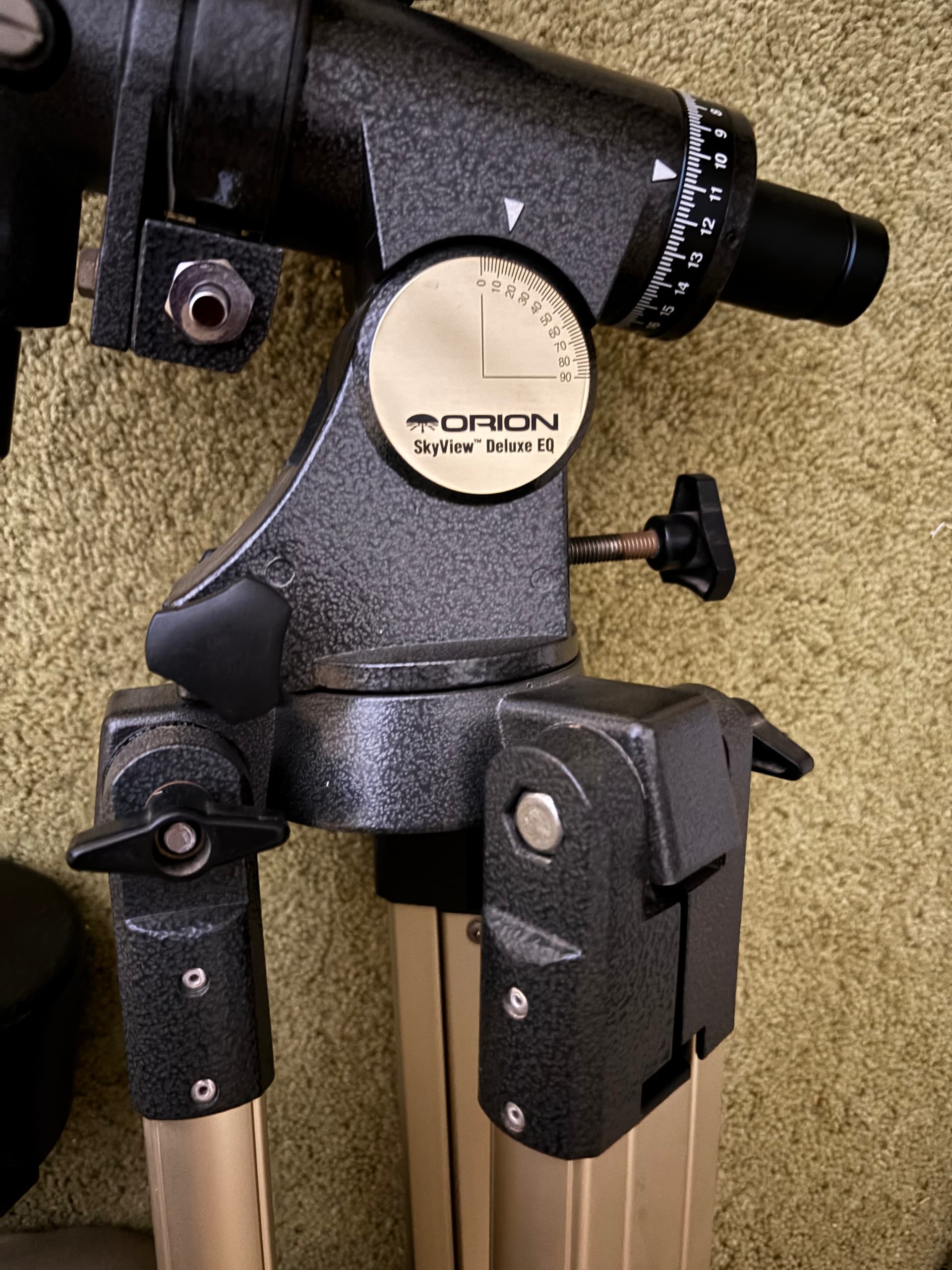
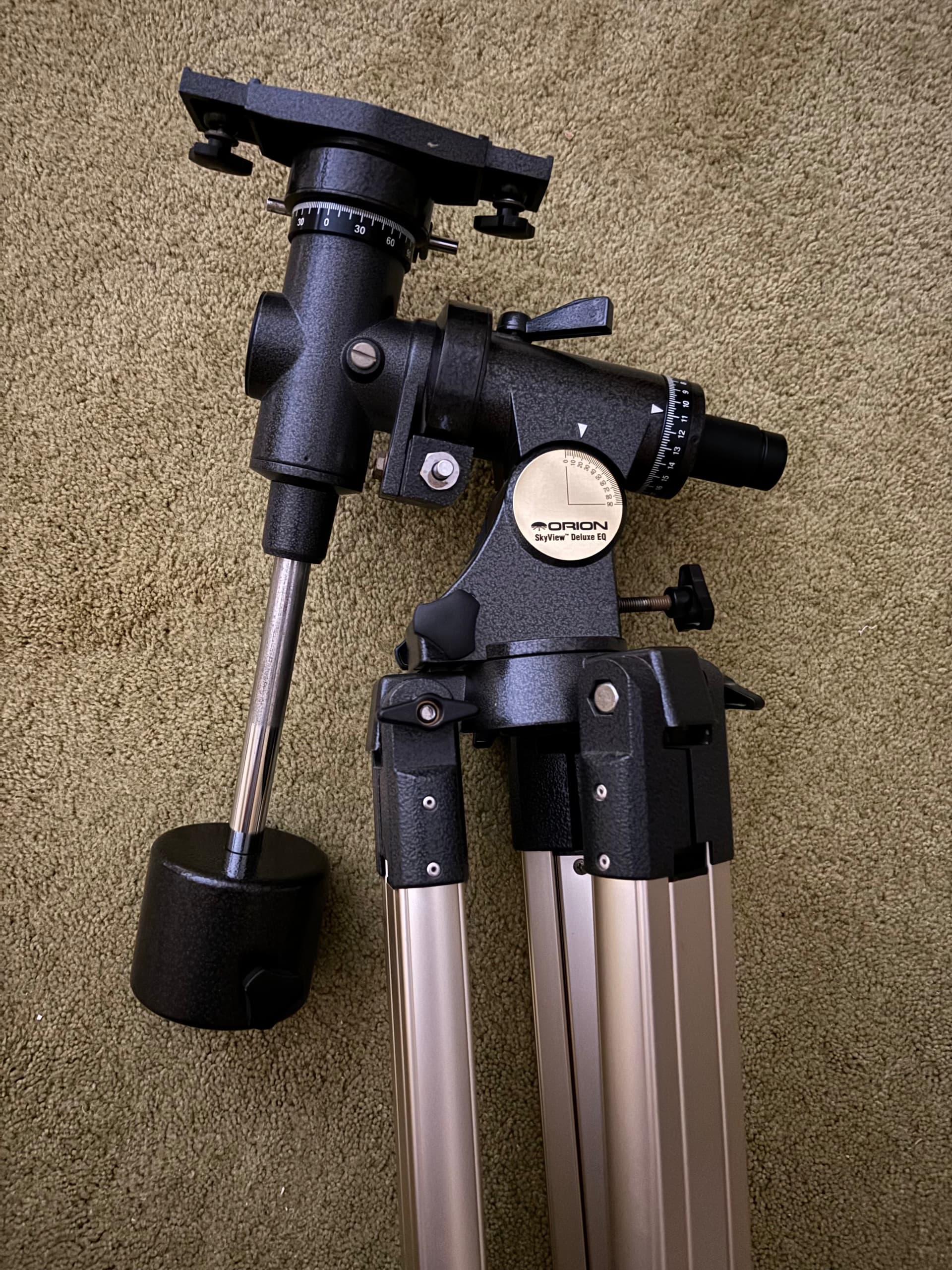
Evening Matthew! Finally got the info on the GEM. It’s an Orion SkyView Deluxe EQ. Sure hope it can be retro fitted with motors to track viewing subjects. If not oh well.
I checked the Celestron web site and the SCT you mentioned is over $5,000 now. Maybe thst invludes the mount? But like you were saying. You get what you paid fore. The sky has finally cleared up. The light pollution here has gotten considerably worse now but I see they have filters for that now. It’ll be interesting to hear your thoughts on retro fitting motors.
Hi Gunns, Welcome back to the hobby!
Astrophotography has changed a lot and is advancing greatly as the years keep rolling by.
One of my first and most standard questions is: Have you decided on What you would like to pursue? That makes a world of difference in what to recommend to you.
For example, I “discovered” the Great Orion Nebula for myself on late fall evening. The rush of actually seeing it set me on course for my fascination of DSO (deep space objects). I took a month deciding IF I wanted to take pictures of things in the night skies. There are probably millions of images available across the web.
My answer was, “Yes. But they aren’t my pictures.” So my pursuit was on.
I spent the next 5 months building my “wish lists” as I learned equipment and studied images and how they came to be. I’d ask when I had a question I couldn’t answer or find an explanation for. One old friend recommended using a small refractor for DSO acquisitions. Made sense, after all I was needing a camera and a telescopic lens like nothing in my DSLR bag. I likened outer space to doing Macro Photography of my miniature jumping spiders. Different lens, different camera.
My first “stab” at DSO was an abysmal failure. Because I trusted old standards in names that turned out to be owned by a corporation in Tiwan. No longer the quality of the past, I followed Brand Names I knew from childhood dreams. A big mistake as I eventually learned.
Over the last 14 years I have recovered and vastly improved on my initial mistakes with my “Best Choice” wish lists. My first GEM type (German Equatorial Mount) was a budget item, A Celestron AVX mount. Mine was one of the bad ones. The electronics failed out of the box, failed again at 8 months, and failed for its last time at 3.5 years. Enough of that dead horse!
My first “real” telescope is an Orion ED80T CF. A Triplet lens in a Carbon Fiber tube. Chosen for the lens design, and the characteristics of the Carbon Fiber tube. That telescope is still in use by our youngest Granddaughters for visual astronomy.
When the AVX died a cold November night, I started looking for a new mount. My CFO/Wife asked me to wait until February to replace it. Virtually blowing away 1/3 of my year and most of the Nebula season.
It proved to be best though. She was disappointed when February rolled in and found me at the Losmandy Factory in Burbank, CA to pick-up my GM811G HD mount. My forever mount.
I explained to Scott I was going to build my Portable Pier Mount, adding the 12" extension to the column. The idea was a mount so solid and sturdy that none of the AVX’s short comings nor electronics problems with Uncle Ho’s crap diodes could ever plague me again. It has proven to the best move I could have made. As was Scott’s sage advice, “Don’t mess with it, just use it.”
I had to unlearn a bunch of bad habits it took to get the AVX to work, but I eventually settled in with my 811 and have succeeded in ways I could only have dreamed of 14 years ago.
About 2 years ago I went on an upgrade rampage. Got my AT130mmEDT, a 5.1" extra low dispersion triplet. Basically, just brings the little stuff closer. Close enough to really capture a screenful. Which works good for my YouTube for Kids presentations.
I decided to go all the way with remote and automatic operation. So I went on a quest to get NINA working. Now, I pick a target(s), set my exposure and number of images, and let her rip.
Not everybody’s cup of tea, but I sleep through the night while my equipment collects the images for me to stack the next morning. Basically, sleeping through the most boring repetitious part of acquisition.
You have a bit to learn to be successful and happy doing AP. Starting with the subject you want to pursue. And it may take several years to get dialed in.
I think Forrest Tanaka sez it best, https://youtu.be/9d0292TBMHo?si=BX8O66SS7hsfGBge
Many think they can process out bad data. I prefer to not record it in the first place. I’m the odd duck that wants to “get it right” in the camera.
So what would you like to take pictures of? Expect to spend a few years of taking picturds as you learn, and learn to use your equipment. I took a lot of picturds learning. But I never gave up.
Can you stick with it until you get it?
Unfortunately, Orion (and Meade) went out of business last year. Your mount apparently does not have a motor drive to track the objects across the sky. A motor drive is essential for long exposure astrophotography.
For astrophotography, it is best to buy a GEM mount (German Equitorial Mount) that is oversized for your OTA (Optical Tube Assembly). The mount should include a motor drive for the RA axis. The other option is to purchase a “smart telescope” that is quite transportable.
That’s a pretty light weight mount . You might keep it for a visual grab and go scope but if you wanna take pictures , be ready to spend some money and have some time to spend on it . I never got into it . To me , the visual part of the hobby , seeing the stuff the best you can eyeball through glass is what I do . Even at that , I have thousands of dollars wrapped up in it . Eyepiece, filters etc . A good dark sky site will beat using any filter made under light pollution . A good dark sky site will beat aperture all night long too .
Do you really wanna take pictures ?
Yes — the older Orion SkyView Deluxe EQ Mount can be fitted with drive motors, although the situation today is a bit complicated because the original Orion drive kits have long been discontinued.
The mount was originally designed to accept at least:
a single-axis RA tracking motor, and
in some cases dual-axis drives.
Older owners report using the original Orion “AccuTrack SVD DC Motor Drive #7825” and various aftermarket adaptations.
A few important details:
The SkyView Deluxe is an older pre-GoTo mount.
It does not have built-in computerized electronics like newer EQ mounts.
Modern EQMOD-style computer control generally does not work directly because the mount lacks a motor control board.
However, people have successfully adapted:
Orion EQ-3 drives,
Celestron logic drives,
Meade motor systems,
and DIY systems like OnStep.
For visual observing, the easiest practical upgrade is usually:
a single RA sidereal tracking motor.
That lets the telescope follow the sky automatically after polar alignment, so you do not have to constantly turn the slow-motion knob.
Because the original Orion kits are discontinued, most owners today find motors through: